Skip to content
[Published: May 13, 2026 | Last updated: May 13, 2026] | 9 min read
- The best blogging platform overall is WordPress.org, which powers over 40% of the web and gives you full ownership of your content (Zoer, 2026).
- Best for beginners: Squarespace, with a Basic plan at $16/month billed annually (SearchEngineInsight, 2026).
- Best free option: WordPress.com or Blogger, both with no upfront cost.
- Best for paid newsletters: Substack, which takes a 10% cut and charges no monthly fee (Substack Support, 2026).
- Best for paid memberships without revenue share: Ghost, starting at $9/month self-hosted (Zoer, 2026).
What to Look for in a Blogging Platform
The right blogging platform depends on three things: what you write, how you want to make money, and how much control you need over your site. A free platform like Medium gives you reach but no ownership. A self-hosted setup like WordPress.org gives you ownership but demands more setup work.
Here are the criteria used to rank each platform in this guide:
| Criterion | Why It Matters |
|---|---|
| Total cost of ownership | Monthly fees, hosting, and revenue cuts add up fast at scale |
| SEO control | Determines whether your posts can rank in Google and get cited by AI search |
| Monetization options | Subscriptions, ads, courses, and ecommerce each need different platform support |
| Ease of setup | A beginner needs a 5-minute launch; a developer needs full code access |
| Data ownership | Can you export your content and subscribers if you switch platforms? |
1. WordPress.org – Best Overall for Full Control
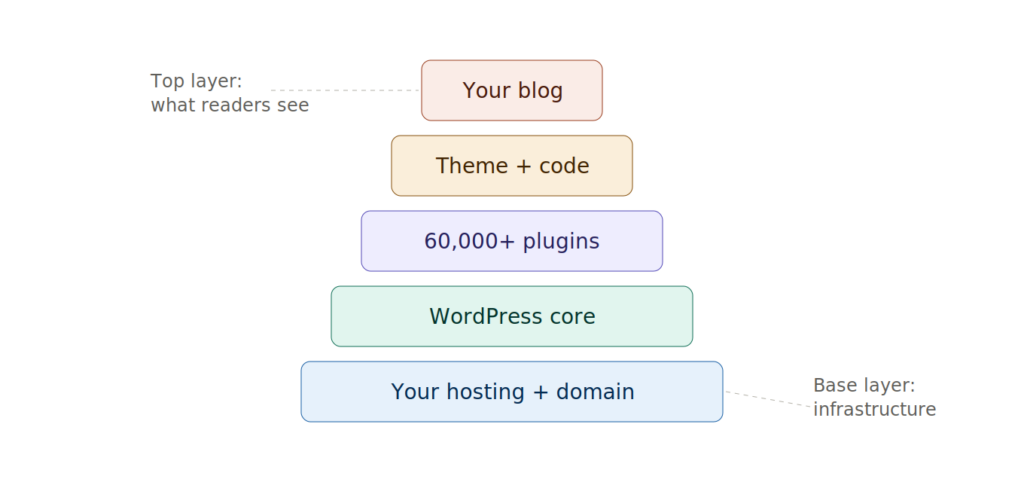
WordPress.org is the self-hosted version of WordPress and powers over 40% of the web’s self-hosted sites (Zoer, 2026). It is the gold standard for bloggers who want full ownership, unlimited customization, and the largest plugin ecosystem available.
You install WordPress on hosting from a provider like Bluehost, DreamHost, or SiteGround. From there, you control every aspect of the site: themes, plugins, code, monetization, and SEO settings.
Key features:
- Over 60,000 plugins for SEO, ecommerce, security, and AI writing (Zoer, 2026)
- Native AI writing assistance in the Gutenberg editor as of the 2026 core update (Zoer, 2026)
- Full data ownership and unlimited export options
- Support for paid memberships, ads, courses, and ecommerce
Pricing: Software is free; hosting runs $3 to $50/month for shared, or $30 to $300/month for managed WordPress hosting (Superblog, 2026).
Best for: Anyone serious about long-term blogging who wants to avoid platform lock-in.
The trade-off: you handle updates, security, and backups yourself. WordPress sites are the most attacked on the internet because of their prevalence and plugin vulnerabilities (Superblog, 2026).
2. Squarespace – Best for Design-Driven Bloggers
Squarespace is an all-in-one website builder with the best template library in the industry. It is the right pick if you want a beautiful, professional blog without writing any code.
The platform replaced its old pricing tiers in late 2025. The new lineup is Basic, Core, Plus, and Advanced (SearchEngineInsight, 2026).
Key features:
- 195+ mobile-optimized templates and the Blueprint AI builder (SearchEngineInsight, 2026)
- Built-in ecommerce, course selling, and memberships on every plan
- Free custom domain and Google Workspace email for the first year on Core and above
- 14-day free trial on every plan, no credit card required (SearchEngineInsight, 2026)
Pricing: Basic starts at $16/month, Core at $23/month, Plus at $49/month, Advanced at $99/month (all billed annually). Monthly billing costs 28-36% more (SearchEngineInsight, 2026).
Best for: Creatives, photographers, and small businesses who care about visual polish.
3. Ghost – Best for Paid Memberships
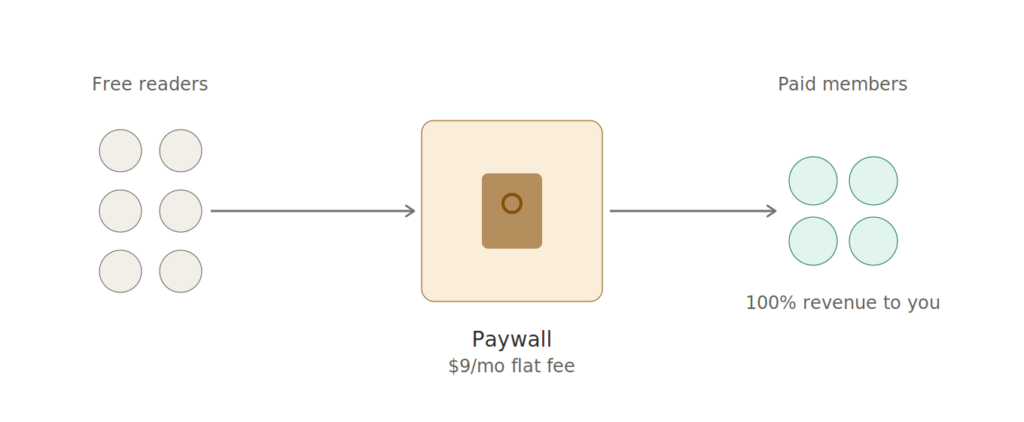
Ghost is an open-source blogging platform built specifically for creators who want to monetize through memberships and paid newsletters. Unlike Substack, Ghost charges a flat monthly fee and takes 0% of your subscription revenue.
That fee structure makes Ghost cheaper than Substack once your newsletter earns more than about $900/month in subscription revenue (CompareTiers, 2026).
Key features:
- Built-in memberships, paid subscriptions, and email newsletter delivery
- Exceptionally fast page loads and clean default SEO (Zoer, 2026)
- Full data portability via JSON export
- Native Stripe integration for paid memberships
Pricing: $9/month self-hosted, $25/month for Ghost Pro hosted plan. Higher tiers run $42-$84/month for advanced features (SchoolMaker, 2026).
Best for: Independent writers and publishers who want to keep 100% of their subscription revenue.
The catch: the theme marketplace is smaller than WordPress, and self-hosting Ghost runs on Node.js, which is less common than PHP and harder to find support for (The Marketing Agency, 2026).
4. Substack – Best for Newsletter Writers Starting From Zero
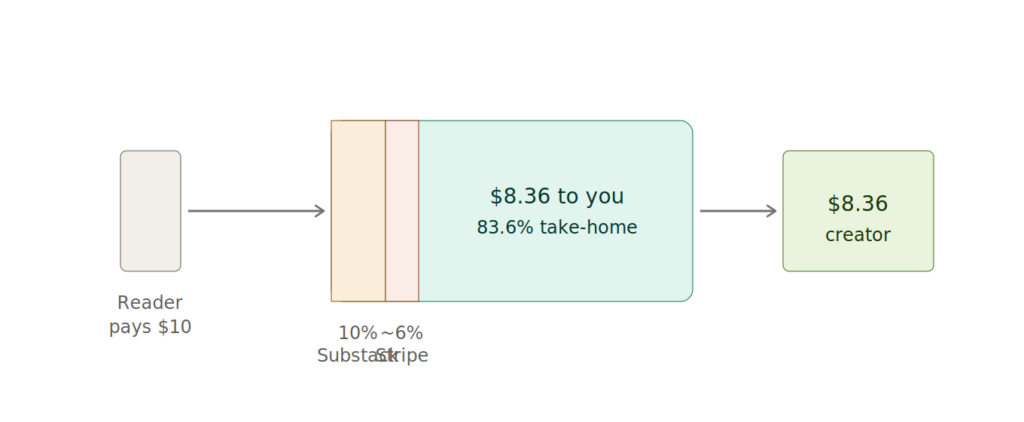
Substack is free to start and only takes money when you do. It charges a 10% cut of paid subscription revenue plus Stripe processing fees, bringing the total cost to 13-16% of gross earnings (Ruzuku, 2026).
There is no monthly fee, no subscriber limit, and no upfront cost. That makes Substack the lowest-risk option for writers who want to test a paid newsletter without any commitment.
Key features:
- Free unlimited email sending to any subscriber count
- Built-in payment processing through Stripe
- Substack Notes, Recommendations, and a mobile app that drives discovery
- Built-in chat feature for subscriber-only communities
Pricing: Free to publish. Substack takes 10% of paid subscription revenue. Stripe adds roughly 3.6% per transaction (Ruzuku, 2026).
Best for: Writers, journalists, and creators who want to focus on writing instead of website management.
The downside: at $5,000/month in subscriptions, you pay about $695/month in combined fees, or over $8,000/year (Ruzuku, 2026). At that scale, a flat-fee platform like Ghost or beehiiv saves money.
5. Medium – Best for Reaching a Built-in Audience
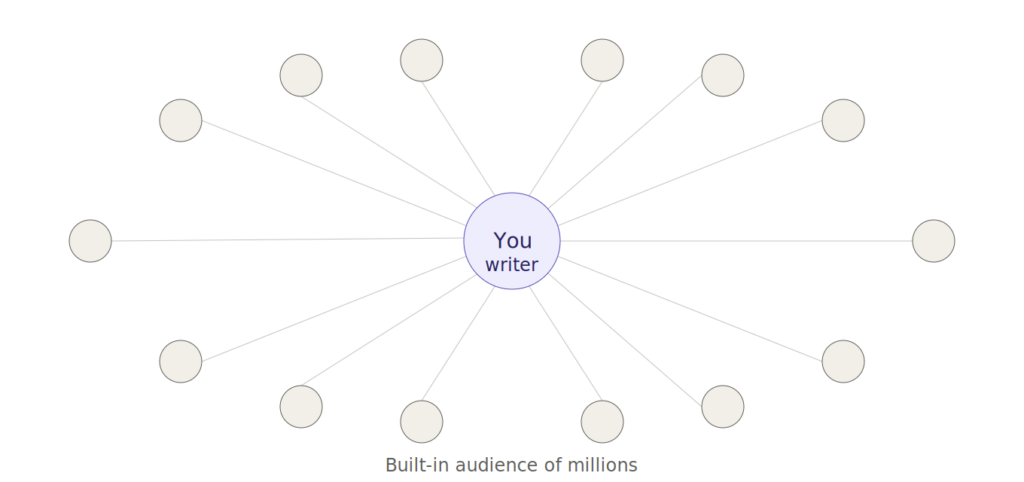
Medium is a content platform with millions of readers already on it. You publish under your profile or a publication, and Medium handles distribution.
Unlike a self-hosted blog, you cannot build a custom brand on Medium. There is no subdirectory hosting, no lead generation forms, and Medium promotes its own $5/month membership to your readers (Superblog, 2026).
Key features:
- Built-in audience and distribution through Medium’s algorithm
- Medium Partner Program pays writers based on member reading time
- Distraction-free writing interface
- Zero technical setup
Pricing: Free to publish. Medium Partner Program is free to join.
Best for: Writers testing ideas, building a portfolio, or wanting reach without owning a website.
The hard limit: you build Medium’s audience, not yours. Switching platforms later means starting from zero.
6. Wix – Best for Drag-and-Drop Beginners
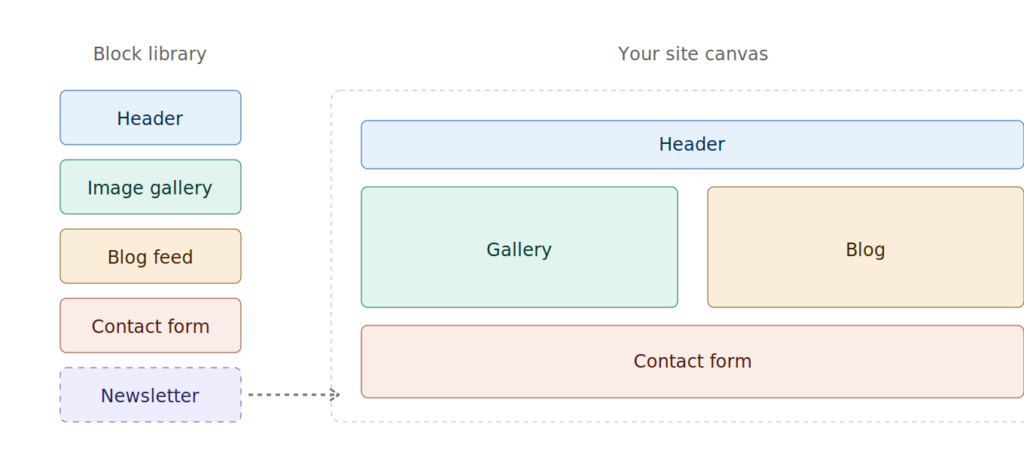
Wix is a hosted website builder with 110+ million users worldwide (WPBeginner, 2026). The Wix Blog app adds blogging to any Wix site, and the drag-and-drop editor needs no coding.
Wix’s Artificial Design Intelligence (ADI) can build a complete blog in minutes based on a few user inputs (Zoer, 2026).
Key features:
- Drag-and-drop visual editor with AI-assisted site creation
- Built-in email campaigns, social sharing, and basic ecommerce
- Hundreds of templates across categories
- Free plan with a limited Wix subdomain
Pricing: Free plan available. Paid plans start at $4/month (Squarespace blog, 2025).
Best for: First-time bloggers who want a working site in under an hour.
The trade-off: Wix has weaker blogging features than WordPress, and migrating off the platform later is hard because Wix uses a proprietary system.
7. Blogger – Best Free Option for Casual Writers
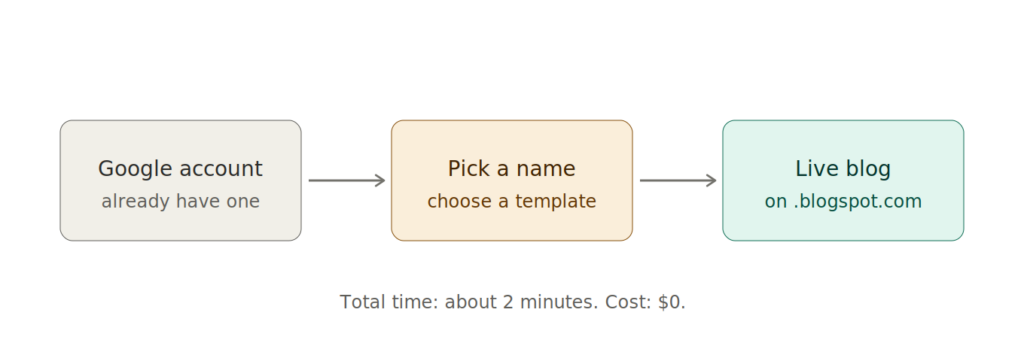
Blogger is Google’s free blogging platform and has been online since 1999. If you can use Gmail, you can use Blogger. Setup takes about two minutes (isitwp, 2026).
There is no paid tier and no upgrade path. That makes Blogger a fine choice for personal journals or hobby blogs but a poor fit for anyone building a business.
Key features:
- 100% free with unlimited posts and bandwidth
- Connects to Google AdSense for ad revenue
- Custom domain support
- Direct integration with Google Analytics
Pricing: Free. Custom domain costs ~$12/year through any registrar.
Best for: Casual bloggers, hobbyists, and anyone wanting a no-cost, no-maintenance blog.
The limits: your blog uses a .blogspot.com subdomain by default, customization is minimal, and Google has frozen most platform development for years.
Comparison Table: Blogging Platforms at a Glance
| Platform | Best For | Starting Price | Revenue Cut |
|---|---|---|---|
| WordPress.org | Full control | $3-50/mo hosting | 0% |
| Squarespace | Design quality | $16/mo annually | 0% on Core+ |
| Ghost | Paid memberships | $9/mo self-hosted | 0% |
| Substack | Newsletter monetization | Free | 10% + Stripe fees |
| Medium | Built-in audience | Free | Partner Program payout |
| Wix | Drag-and-drop ease | $4/mo | 0% |
| Blogger | Free hobby blogs | Free | 0% |
Common Mistakes When Choosing a Blogging Platform
- Picking the cheapest option first: A $5/month platform you use consistently beats a free one that frustrates you into quitting (The Marketing Agency, 2026). Total cost of ownership matters more than the headline price.
- Ignoring data portability: Substack does not export subscriber email addresses, and Wix uses a proprietary system that makes migration hard (Zoer, 2026). Check export options before you commit.
- Choosing based on traffic potential alone: Medium gives you reach but you build their audience. WordPress.org gives you slower growth but full ownership.
- Underestimating maintenance load: WordPress.org needs updates, security plugins, and backups. Hosted platforms like Squarespace and Ghost Pro handle all of this for you.
Frequently Asked Questions
What is the best blogging platform for beginners in 2026?
Squarespace and Wix are the best blogging platforms for beginners because both use drag-and-drop editors and need no coding. Squarespace has better templates; Wix has a more generous free plan. For total beginners who want zero setup, Substack and Medium let you publish in under five minutes.
Are there free blogging platforms worth using?
Yes. WordPress.com, Blogger, Medium, and Substack are all free to start. WordPress.com is best if you may upgrade to a paid plan later. Blogger is best for hobby blogs. Medium and Substack are best for writers who want a built-in audience.
What is the difference between WordPress.com and WordPress.org?
WordPress.com is a hosted service where Automattic manages the technical side and limits what plugins you can use on free and lower tiers. WordPress.org is the free, self-hosted software you install on your own hosting account, which gives you full plugin access and complete ownership.
How much does Substack cost?
Substack is free to publish. When you charge for paid subscriptions, Substack takes 10% of revenue and Stripe takes another 3-3.6% in processing fees (Ruzuku, 2026). On $1,000/month in subscriptions, you pay about $135 in combined fees and keep about $865.
Which blogging platform is best for SEO?
WordPress.org has the strongest SEO control because of plugins like Yoast SEO and Rank Math, plus full schema and sitemap access. Ghost has the best out-of-the-box SEO with no plugin work needed. Squarespace handles core SEO well but offers less fine-grained control than WordPress.
Can I move my blog from one platform to another later?
Yes, but the difficulty varies. WordPress and Ghost both export full content as standard files (XML or JSON). Substack lets you export posts but not paid subscriber email addresses. Wix and Squarespace use proprietary systems that make full migration manual and time-consuming.
Final Verdict
The best blogging platform overall is WordPress.org because it gives you full ownership, the largest plugin ecosystem, and no platform lock-in. Plan for $5-25/month in hosting and accept the maintenance work.
If WordPress sounds like too much, Squarespace at $23/month (Core plan) is the best all-in-one alternative for design-focused bloggers. For writers building a paid newsletter, start on Substack for zero risk, then switch to Ghost once you cross $900/month in subscription revenue (CompareTiers, 2026).